
Ant keepers contribute to the science of colony foundation by parasitic Lasius
In a recent study published in Current Biology, “Socially parasitic ant queens chemically induce queen-matricide in host workers“, Taku Shimada and colleagues reported a new mechanism for eliminating the host Lasius spp. queens by parasitic Lasius umbratus which was discovered by “ant-keepers”. Careful observations by “amateur” students of ants – amateur in the best sense of those who love their subject of study – resulted in this fascinating new knowledge. The finding is the result of a high level of interest, coupled with patient and careful observations of captive colonies of two potential host species of Lasius into which queens of the parasitic species L. umbratus were introduced. Their observations revealed that the L. umbratus queens did not undertake the possibly perilous approach of directly attacking and throttling the host queens, but instead utilized the apparently safer approach of dabbing the host queen with abdominal secretions that induced the host workers to kill their own mother.
In this interview the last author Keizo Takasuka, answers some question about this interesting research.
An interview of Keizo Takasuka
Edited by James Trager and Salvatore Brunetti

MNB: Could you tell us a bit about yourself?
KT: My specialization is the ecology of spider-parasitic wasps known as the polysphinctines (Ichneumonidae, Pimplinae, Polysphincta group). I am especially interested in host manipulation in which these wasps alter spider web-building to induce webs that benefit the parasite (e.g. Takasuka et al. 2015 J. Exp. Biol.). In other words, I am not an ant specialist, and this paper is actually my first on ants. That said, the study still concerns host manipulation, so it aligns very closely with my interests. The fact that ants are also Hymenoptera may have made the writing smoother.

MNB: Could you briefly outline your research on “Socially parasitic ant queens chemically induce queen-matricide in host workers” in layperson’s terms?
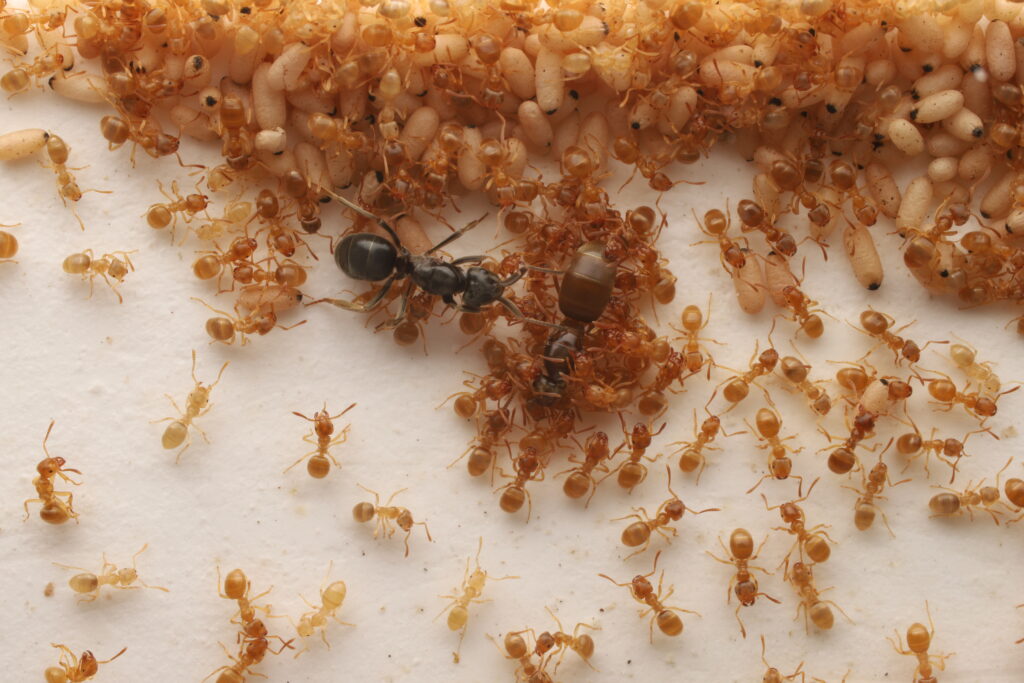
KT: Some ants are temporary social parasites: they take over another species’ colony, eliminate the resident queen, and exploit the host workers’ labor. In this lifestyle, parasitism cannot succeed without removing the host queen, so every temporary social parasite must accomplish queen-killing somehow—yet for most species the method is unknown.
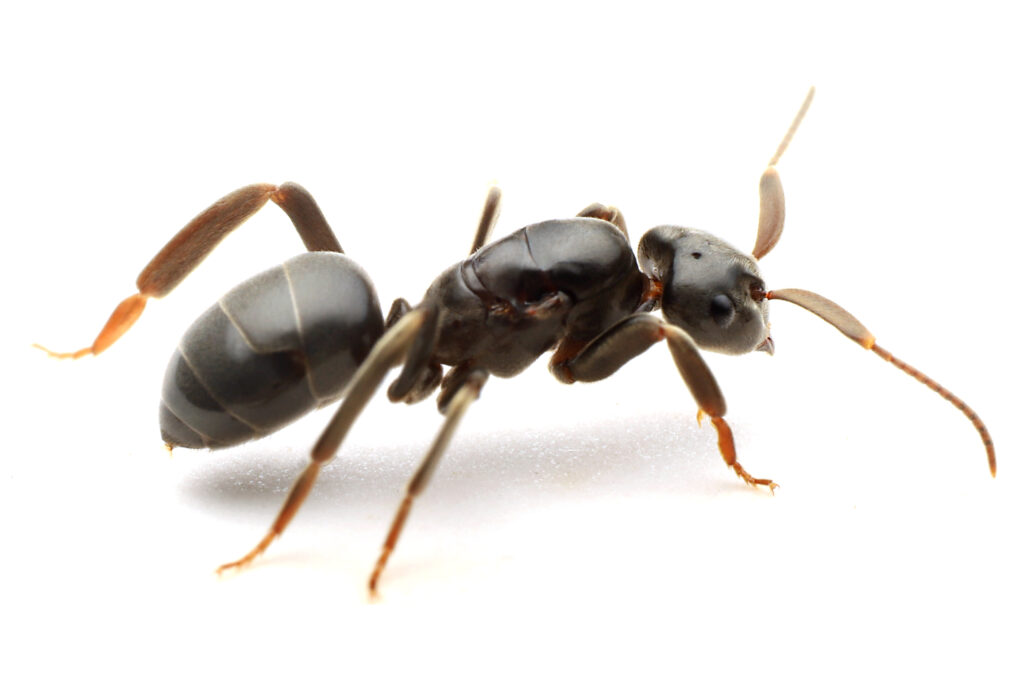
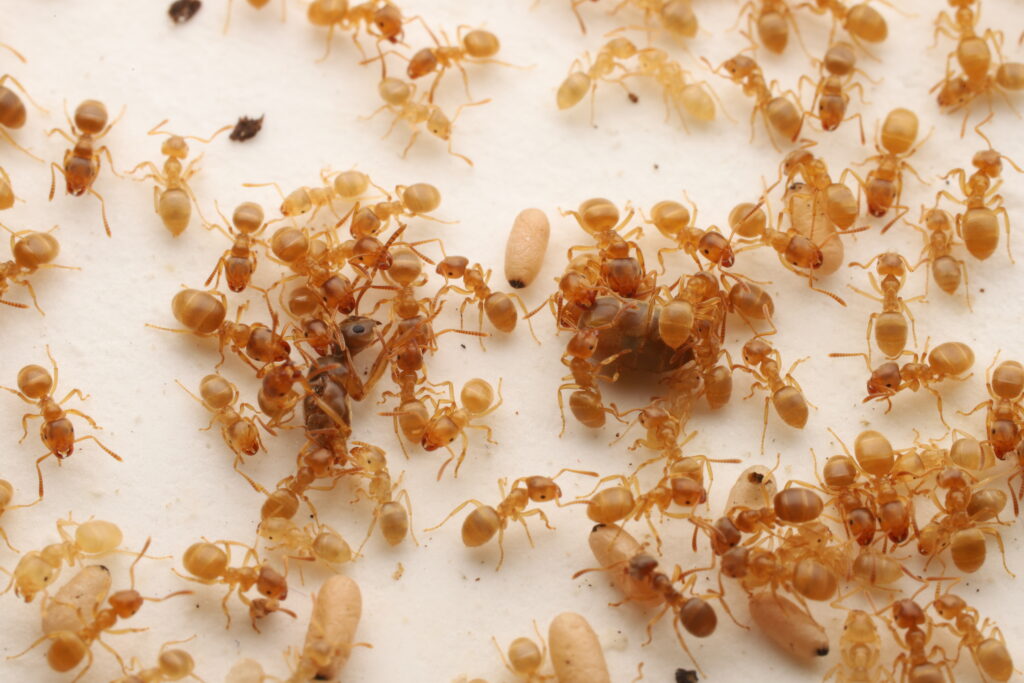
Using newly mated queens of Lasius orientalis and L. umbratus with established host colonies (L. flavus and L. japonicus) under captive conditions, we asked how the invaders eliminate the host queen. We found that the parasitic queen precisely sprays a fluid from her abdomen onto the host queen; this causes host workers to misidentify their own mother as a menace and to attack persistently until she is killed.
MNB: What is the take-home message of your work?
KT: Social parasitism in Lasius orientalis and L. umbratus has separate origins within the same genus (Maruyama et al. 2008, BMC Evol. Biol.; Boudinot et al. 2022, Syst. Entomol.), so the apparently identical “induced matricide” strategy in these two species represents convergent evolution. Moreover, within the socially parasitic clade that includes L. umbratus, L. reginae is known to eliminate the host queen by direct throttling (Buschinger 1986, TREE), suggesting shifts among lineages in how the host queen is removed. Going forward, we need to examine other Lasius social parasites to learn which strategies they use—ideally extending the same questions to socially parasitic ants beyond Lasius.
MNB: What was your motivation for this study?
KT: To be frank, I did not conduct the experiments or observations. Enthusiastic ant lovers who are my co-authors discovered these phenomena at home, and I organized their findings into a paper. My motivation was that, after seeing their major discoveries posted online, I felt it would be a real loss if they were not formally recorded as scientific knowledge—so I was determined to help bring them to publication.
MNB: What was the biggest obstacle you had to overcome in this project?
KT: Although I was not involved in the experiments, Mr. Shimada (the first author) observed host workers killing the host queen after L. umbratus intrusion about 20 years ago. The fact that it took so long to reach an opportunity to uncover the mechanism underscores how difficult it is to obtain live material and set up workable arenas for these systems.
MNB: Do you have any tips for others who are interested in doing related research?
KT: For intrusion experiments with socially parasitic ants, a host-odour pre-acquisition treatment is crucial. Please see the paper’s Supplementary Information for details.
MNB: Where do you see the future for this particular field of ant research?
KT: Although I study parasitoid wasps rather than ants, parasitism and host manipulation are shared themes, and my interest is inexhaustible. Social parasitism also has a distinctive place within parasitology. I look forward to more of the fascinating biology of socially parasitic ants being revealed. I will not be running the experiments myself, but if enthusiasts make further interesting discoveries, I fully intend to help bring them to publication.







Recent Comments