Why developmental biology needs natural history: the case of Hylomyrma primavesi
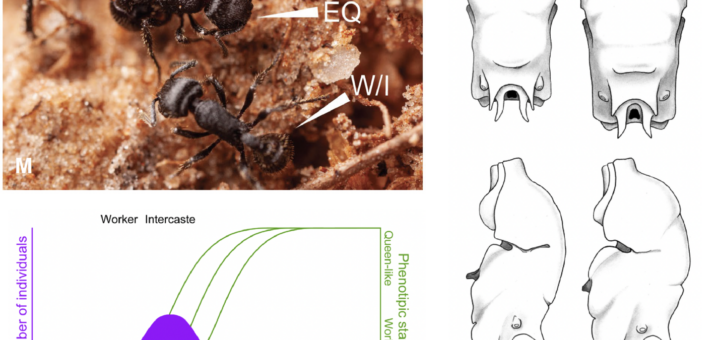
A View by Brendon BoudinotEdited by Alice Laciny and Patrick Krapf In the recent paper “Biological notes, nest architecture, and morphology of the remarkable ant...
In the recent paper “Biological notes, nest architecture and morphology of the remarkable ant Hylomyrma primavesi Ulysséa, 2021 (Hymenoptera: Formicidae: Myrmicinae)” published in Myrmecological News,...
Deep learning in computer vision is revolutionising the study of animal behaviour. Despite the advantages of transfer learning for non-model species, it relies on manual...
The Myrmecological News Blog has been online for over five years now (wow – since May 2018), and each year, Myrmecological News Blog and its...
In the recent article “Harbouring Blochmannia incurs costs: a trade-off between the necessity of the obligate primary endosymbiont for brood development and its costs for...
In most organisms, reproduction usually leads to a shorter lifespan. However, in eusocial insects the queen lives much longer than the worker ants. In the...
In this photoblog contribution, Phil Hoenle shares some amazing pictures taken during his field work in Papua New Guinea in 2022. Enjoy! A Photoblog contribution...
Hello everyone, I hope you had fun in the previous post, connecting the dots to find out the ant. Are you ready for another ant...
In the recent study “Urbanization influences the trophic position, morphology, and colony structure of invasive African big-headed ants (Hymenoptera: Formicidae) in Taiwan”, Peng et al.*...
In the article “Absence of genetic isolation across highly fragmented landscape in the ant Temnothorax nigriceps” published in BMC Ecology and Evolution, Marion Cordonnier, Dominik...
Recent Comments