In their recently published paper, “A new densovirus from the tropical fire ant with widespread distribution in Taiwan“, authors Chen et al. report the discovery of a novel densovirus from the tropical fire ant. As a globally distributed invasive species, Solenopsis geminata has widespread effects on economy and agriculture, making new discoveries about its biology particularly impactful. In this photoblog, the authors share the process of locating, excavating and caring for the ant colonies they use to conduct their research.
In most cases, our collection sites are in the countryside. The best places are the locations that no one takes care of or just ignores, for example, fallow land. But sometimes local farmers will also contact us to remove the whole colony, and we will just bring it back to our lab.
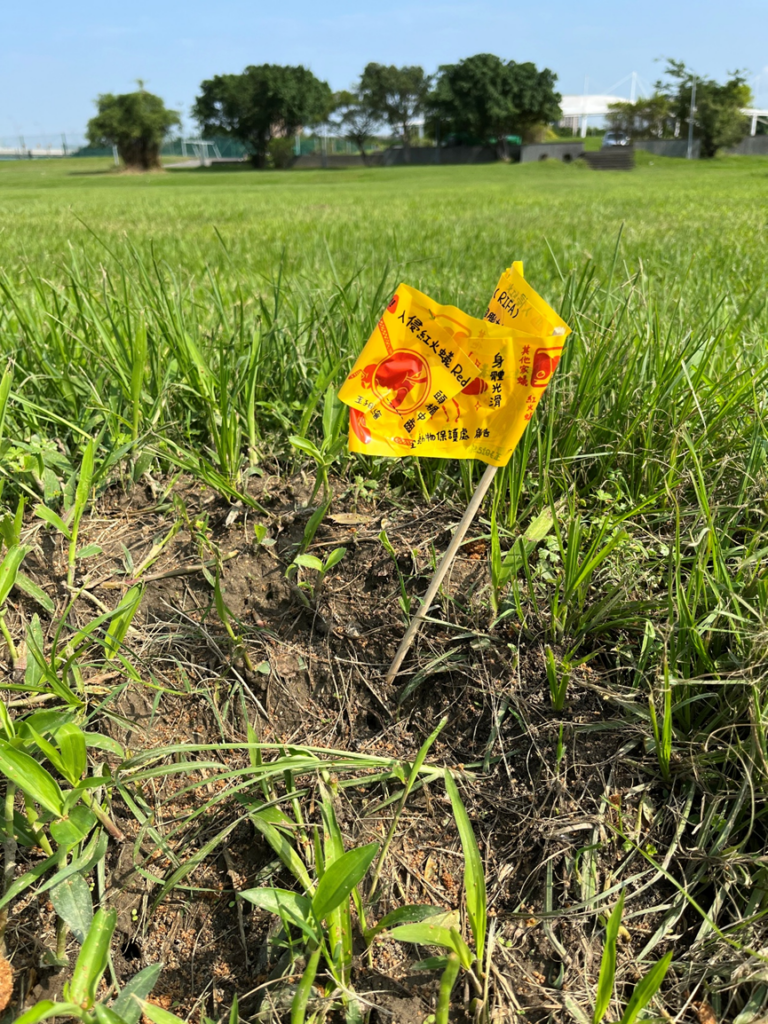
In Taiwan, the fire ant is a pest that causes many negative effects, such as damaging ecosystems and public infrastructure. Furthermore, they can sting people and cause serious health consequences (Liu, Y.-S. et al. 2021). For this reason, the government is trying to control them, and the first step is to label the colonies as shown in the photo. Since the chemical pesticides used by the government could really affect our experiments, we need to collect the colonies beforehand.
The colonies of the fire ant are mounds with many soil particles on the surface. These soil particles come from digging behavior, so the number of particles on the surface can also be considered to correlate with the activity level of the colony.
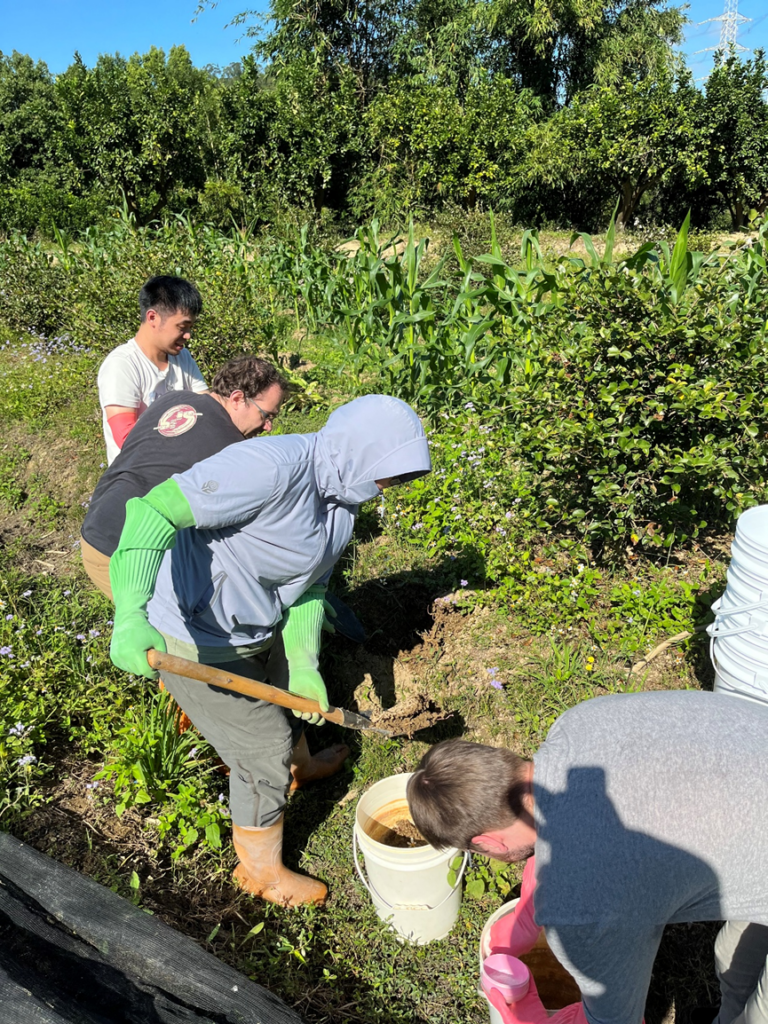
To protect ourselves, we will wear long gloves and boots with powder on the surface. Even if it is temporary, the powder will make the ants fall off while they are trying to climb up. Generally, we will use round shovels to dig out the colony and the soil and collect them in buckets with powder to prevent them from escaping.
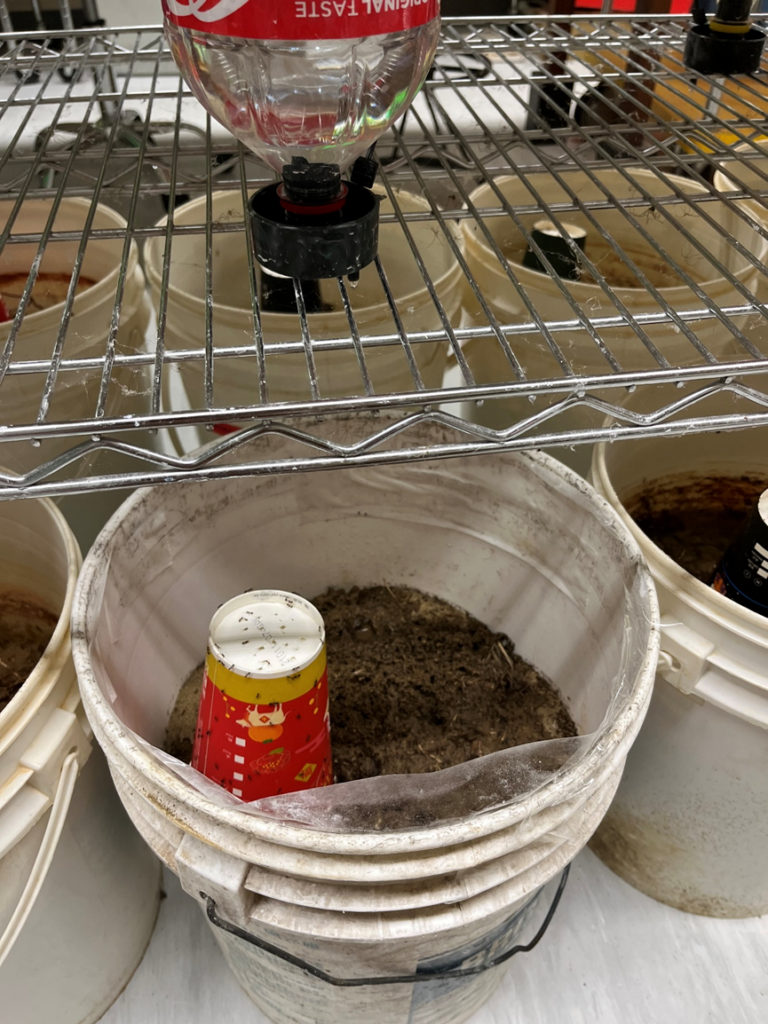
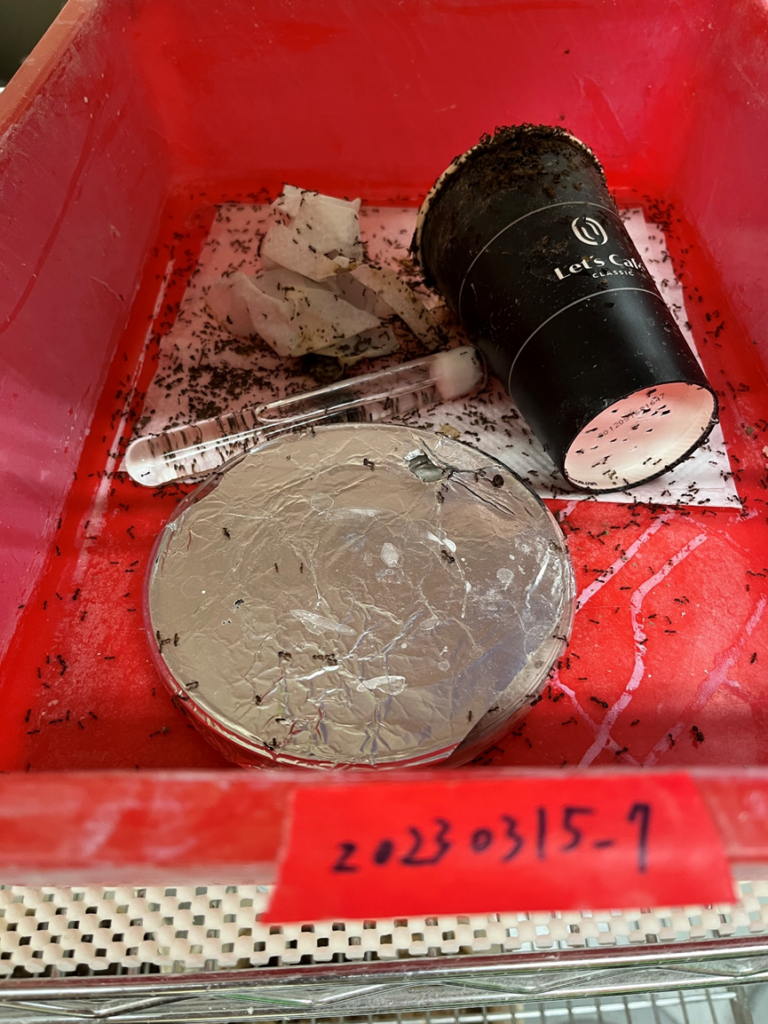
After going back to our lab, we will put a paper cup with tissue paper inside to make it easy for ants to stay in. At the same time, we will continuously drip water in to force the ants to move the whole colony into the paper cup.
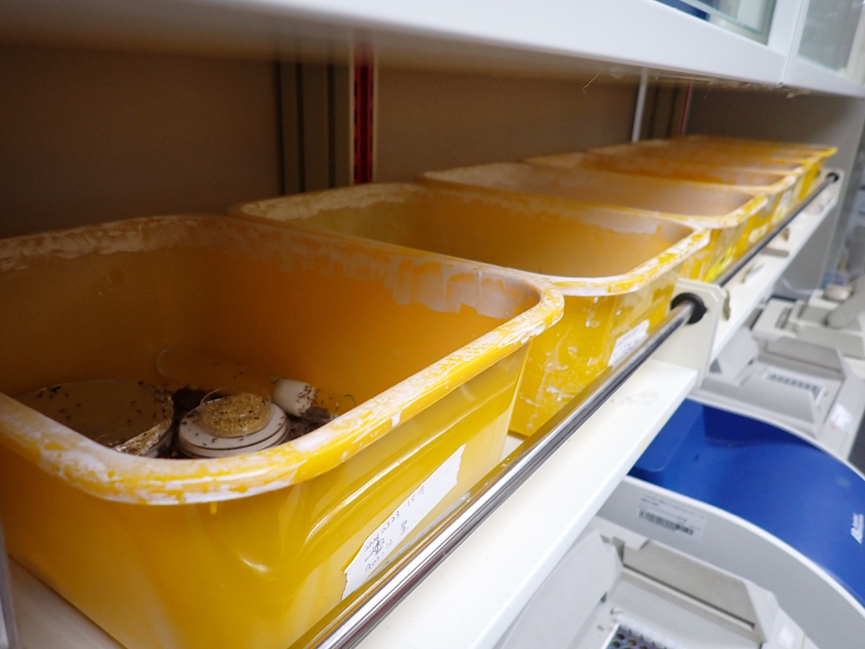
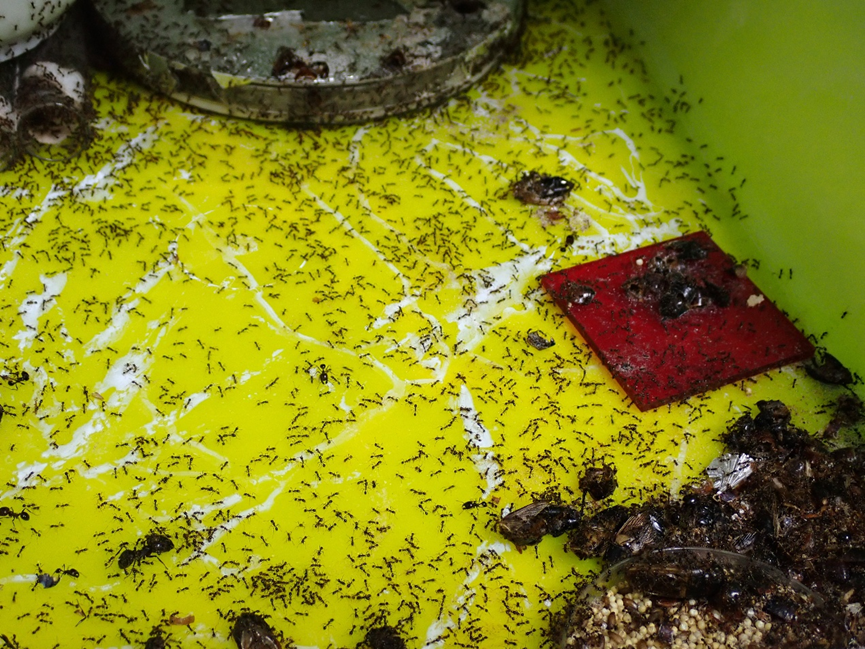
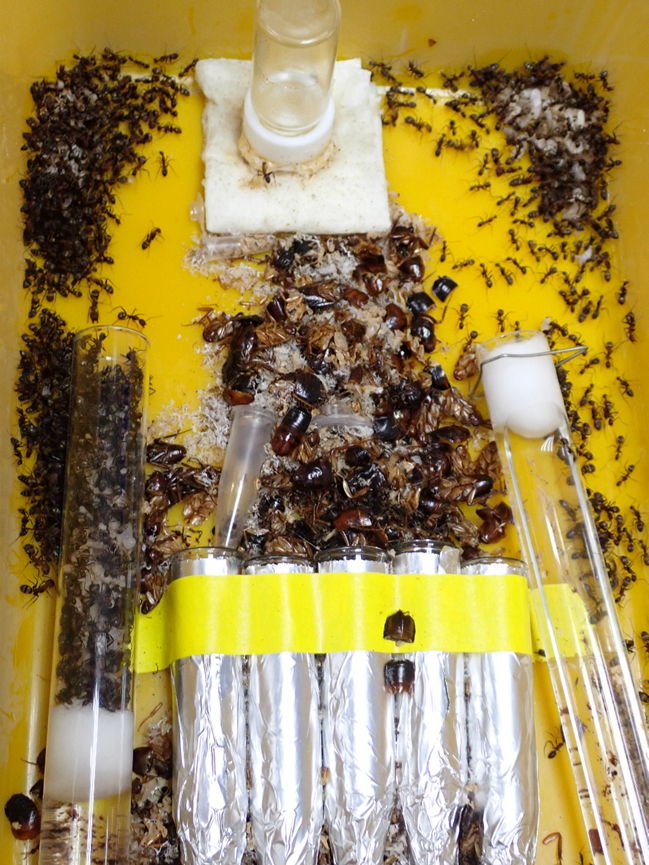
When the whole colony has moved into the paper cup, we can transfer the cup into a basin with its inside wall coated with Fluon to prevent the ants from coming out. We will also provide a Petri dish with plaster for them as the nesting place and a test tube with water. Additionally, honey, crickets, peanuts, etc. will also be provided as food.
Video showing ground movement
Despite focusing on the fire ant, we are also interested in other species of ants, so we also collect them if we have the chances. Sometimes, we also find some cool stories in them, such as a new densovirus found in the tropical fire ant, which we recently reported in Myrmecological News.
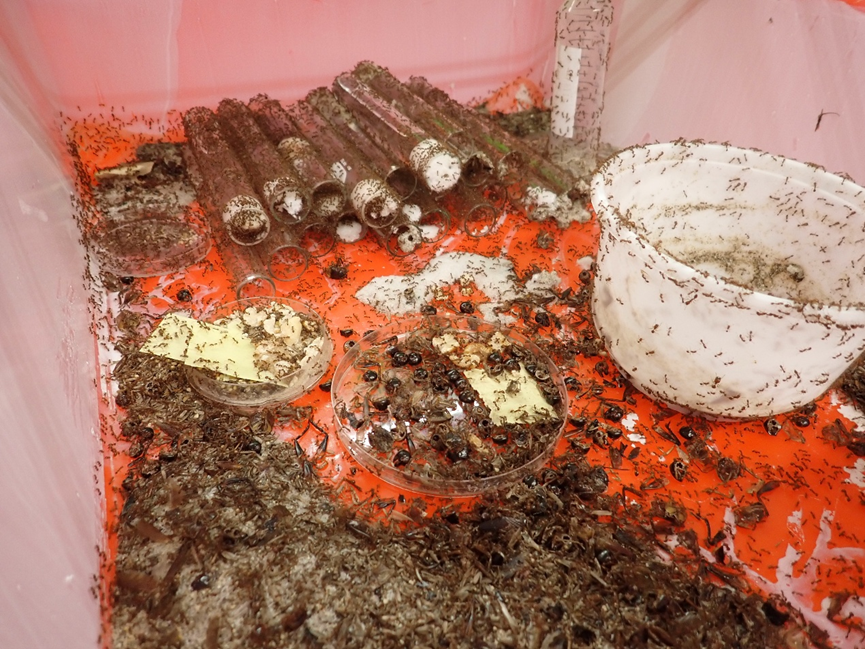
This is a colony of Solenopsis geminata, the tropical fire ant. They are seed collectors, but we still provide different foods instead of only seeds.
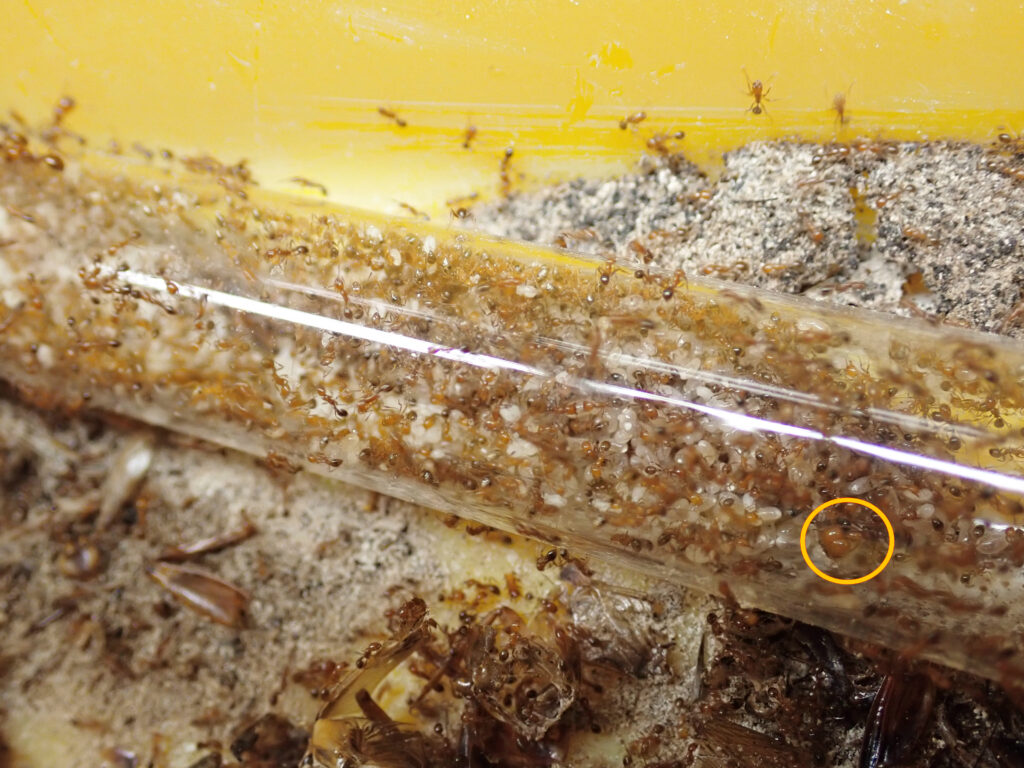
Different from the fire ant Solenopsis invicta, the tropical fire ant has a soldier caste which makes it easier for them to process seeds. The individual with a bigger head, close to the bottom right side in the test tube is from the soldier caste.
We also have some other ant species. Here I choose two to share with you. The first is Carebara diversa, the Asian marauder ant. The signature feature of this ant species is that they have different sizes of super-large soldiers, even around 16 times larger (550 times heavier) as the smallest workers, which is really impressive.
The second is Camponotus habereri, Haberer’s carpenter ant. It is a large, pretty, and relatively common ant species in the wild. One interesting feature of this species is that its pupae are enclosed in cocoons, unlike those of fire ants or the Asian marauder ants, which have naked pupae. I think it’s quite interesting to see how different ant species develop in different ways!
Myrmecological News Blog is an international, non-profit, independent ant blog devoted to myrmecology and related fields.
It offers various contributions on all fields of ant research, in a lively mix of short posts on journal articles, (flash) interviews with researchers, photoblog contributions, views and reviews, book reviews, etc.











Recent Comments