
Morphology is not dead!
Recently, research on ants has increasingly focused on molecular approaches. However, there is a need for classic taxonomy, as demonstrated in the following article.
A new paper “Taxonomy of the ant genus Aphaenogaster MAYR, 1853 (Hymenoptera: Formicidae) of China with descriptions of fourteen new species and a key to the known species of China and adjacent continental countries” by Xin-Min Zhang, Jia-Huan Duan, and Zheng-Hui Xu tackled the extremely difficult task of examining the morphology of 52 species of the genus Aphaenogaster from China and adjacent countries. This genus, in the subfamily Myrmicinae, is widespread and ecologically significant due to its scavenging behavior, arthropod feeding, and seed dispersal. They are known to prefer undisturbed forest and desert areas, unlike other ant genera that thrive in disturbed areas. The genus currently comprises 205 species worldwide. The 52 species in China and surrounding countries account for ¼ of the known species in this group, being present in other ecosystems but not in the desert.
A review by Bernice DeMarco

Edit by Lina Pedraza and Salvatore Brunetti


The major contribution of this paper is the description of 14 new species from China, including Aphaenogaster changuli, A. danba, and A. lisheni. These species, along with the additional 38 species in this paper, are described in detail, including head shape, scape length, and body sculpturing. Additionally, four species of the genus originally thought to occur in China were not found and excluded from the country’s list of species based on possible misidentification. The authors also established a new synonymy, determining that Aphaenogaster pumilopuncta is not a distinct species but a junior synonym of A. incurviclypea.
The authors included a checklist comprising 52 species from China and neighboring countries, 42 of which are confirmed to occur in China. They also produced a taxonomic identification key based on the morphology of worker ants and original images of type specimens. Digital images from their work, as well as from AntWeb and AntWiki, provide a valuable resource to aid in the identification of these ants.uable resource to aid in the identification of these ants.
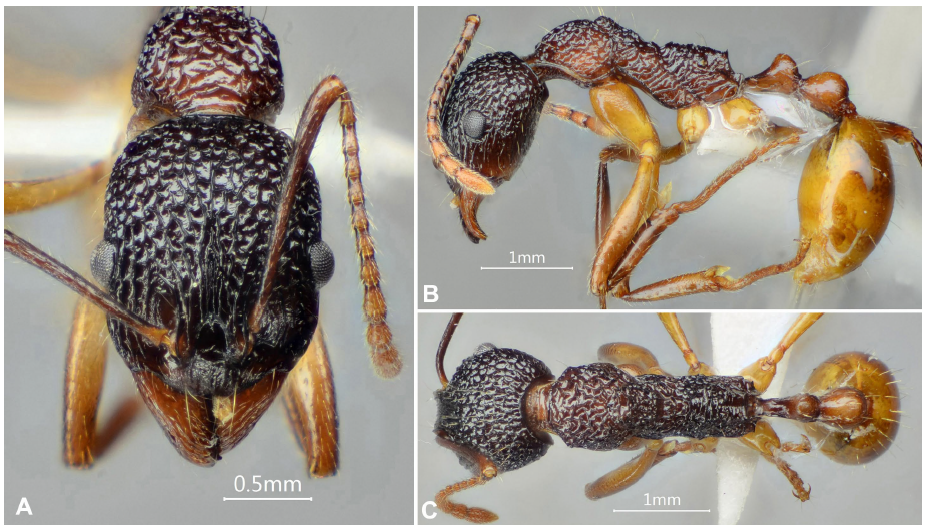
China spans a wide geographic area, including both Holarctic and Tropical regions. A strength of this manuscript is its demonstration of ant biodiversity in China across both regions. Recent studies have raised the possibility that the genus Aphaenogaster might not be monophyletic and consists of distinct Holarctic and Tropical clades (Branstetter & al. 2022). By combining the information from China with data from other regions worldwide, future research using both morphological and molecular data may determine whether Aphaenogaster is monophyletic or requires further revision. This creates an opportunity for additional research using phylogenetic methods to resolve evolutionary questions regarding this group. Having said this, the value of this paper is that it serves as a starting point for researchers to go out into the field, take a hands-on look at species and their habitats, before going into the lab to examine molecular data. Then a phylogeny can be constructed to determine the actual relationships among these species. There is much to be discovered, and this paper opens a great opportunity to continue researching this genus. As an example from my prior research in North America, a combination of morphological and molecular data concluded that the original 26 NA species of Aphaenogaster were determined to be two different genera, 23 species of Aphaenogaster and 3 of Novomessor, a genus found solely in the deserts of the Southwest (Demarco, B. B. & Cognato, A. I. 2015).
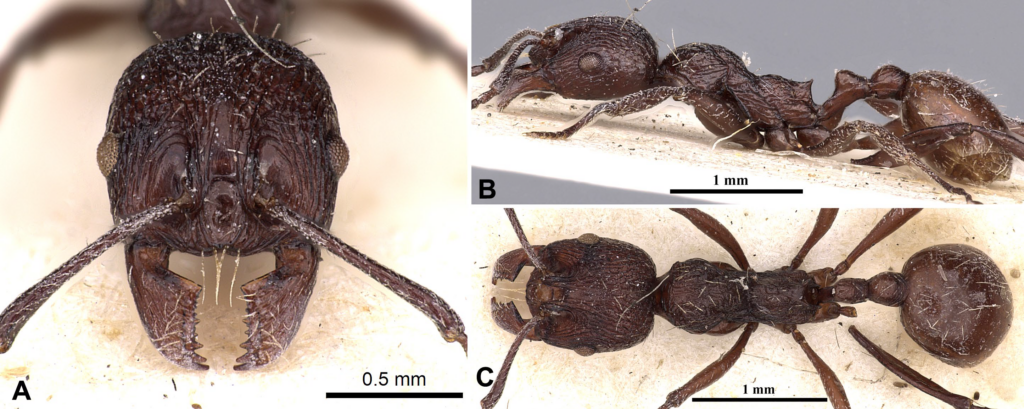
In conclusion, this article presents a significant revision of the genus Aphaenogaster in China and surrounding regions, including the discovery of new species, taxonomic updates for species in the study area, and an examination of the biogeography of these ants. This expands our knowledge of this group, which allows for future study and understanding of ant biodiversity.
References
Branstetter, M. G., Longino, J. T., Reyes-López, J. L., Brady, S. G. & Schultz T. R. 2022: Out of the temperate zone: a phylogenomic test of the biogeographical conservatism hypothesis in a contrarian clade of ants. Journal of Biogeography 49(9):1640-1653.
DeMarco, B. B. & Cognato, A. I. 2015: Phylogenetic analysis of Aphaenogaster supports the resurrection of Novomessor (Hymenoptera:Formicidae). Annals of the Entomological Society of America,108, 201–210.







Recent Comments