
Digging through the desert to uncover the secrets – and the knowledge gaps – of honeypot ants
Honeypot ants are iconic in the ant world and beyond for both their visual appearance and their fascinating lifestyle. Highly specialized workers with astonishing enlarged gasters are a particularly striking representation of how ant colonies’ “social stomachs” can work. Initially born equal to their sisters in the colony, these workers sacrifice their ability to walk around to act as a living reservoir of food and water. Not only representing a textbook example of extreme labor division in insect societies, but also a fascinating case of convergent evolution, with many different ant lineages developing this lifestyle.
Deep under the soil of the desert and harsh environments that favored this bizarre adaptation, honeypot ants still hold a lot of secrets. Bianca R. Nogueira and Lily Khadempour from Rutgers University (Newark, New Jersey, USA) have produced a much-needed review entitled “Honeypots: A Review of Repletism Across the Ants“, analyzing the very definition of what a honeypot ant is, discussing their secretive lifestyle and evolutionary history, and highlighting many promising paths for future investigations through their synthesis of the available knowledge. In this interview, they offer us many interesting answers on their journey and the motivations that led them through it, hinting at some of their next steps.
Edit by Enrico Schifani and Salvatore Brunetti


A Review by Bianca R. Nogueira and Lily Khadempour


MNB: Could you tell us a bit about yourself?
BN: I’m a PhD candidate at Rutgers University, originally from Brazil, and I came to the U.S. to study honeypot ants. I’ve been working with ants since my undergrad, mostly focusing on the behavior and immunology of leaf-cutter ants during that time. During my master’s, I shifted subjects a bit and studied forensic entomology, looking at the ecology of carrion-associated ants. Right now, I’m interested in studying the convergent evolution of honeypot ants and their associated gut microbiome.
LK: I’m an assistant professor at Rutgers University, Newark in New Jersey, USA. Prior to this, I did a postdoc at California State University, Northridge, and before that I did my PhD at the University of Wisconsin-Madison. But I actually grew up in Canada and did both my undergraduate and masters at the University of British Columbia.
I am primarily a microbiologist but I have mostly worked with microbes associated with insect systems for most of my research career. My masters research was about mountain pine beetle-associated fungi, and then in my PhD I turned to studying leaf-cutter ant-associated microbes, and after that I just looked for ways to keep studying ants. Now my lab is focused on microbes associated with honeypot ants, and the honeypot ant system more broadly.
MNB: Could you briefly outline your research on “Honeypots: a review of repletism across the ants” in layperson’s terms?
BN: Honeypot ant species have repletes in their colonies, which are individuals specialized in storing food. They keep large amounts of liquid in their stomachs, which are located in their abdomens, causing them to get abnormally distended –basically, they’re ants with really big butts! Although these ants have been studied before, we still lacked an updated, unified definition of the repletism syndrome across honeypot species. This review brings together what we currently know about the diversity, morphology, physiology, and development of these ants and highlights what we still don’t know and should explore further. We hope this review helps draw more attention to this fascinating group so that we can keep learning more about them!
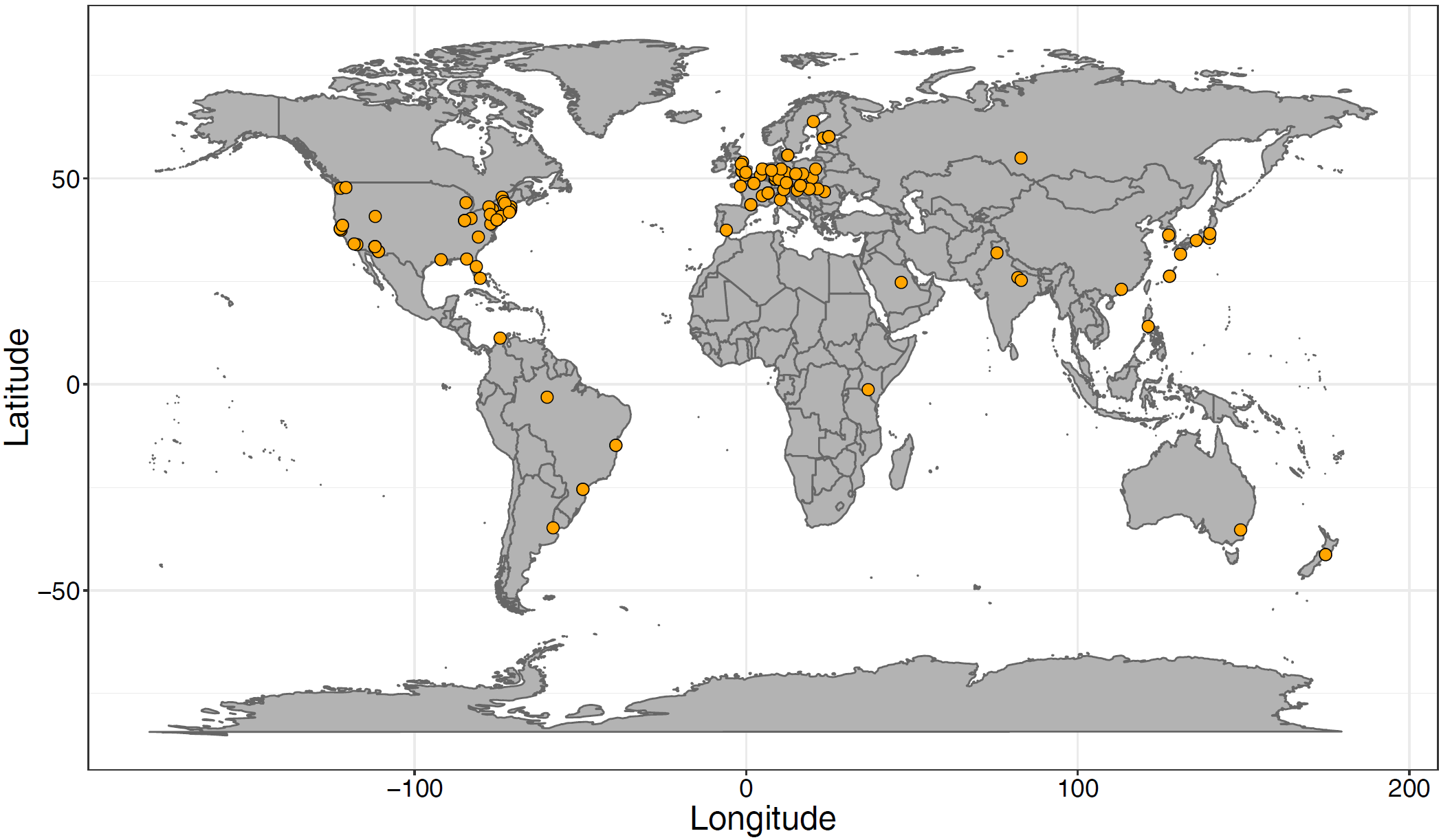
LK: Honeypot ants are amazing animals that have seemingly adapted to living in desert habitats by storing water and food in their crops (also known as their social stomachs). My lab wanted to study these ants because they represent an example of convergent evolution: unrelated species of ants around the world have similar morphology and life history, we think because they are adapted to living in deserts. The first question we had was, “what are all the honeypot ant species in the world?” It turns out, there was not a straightforward answer to this question. There have been many ants that have been called honeypot ants, that don’t store food in their crops, they just look similar because they have large gasters, filled with expanded fat bodies, or they have other characteristics that somewhat resemble honeypot ants. So we had to clarify our definition of what we consider a honeypot ant and then conduct a thorough review of the literature to categorize known ant species as honeypot ants, non-honeypot ants, and those that may be honeypot ants but for which we need more data. In this review, we also show the global distribution of honeypot ants and how they are distributed throughout the ant phylogeny.

DiemQuynh Nguyen, me and Bianca Nogueira in California, digging a honeypot ant colony. As a note, DiemQuynh is a middle author on this paper and another graduate student in my lab. Photo was taken by John Truong.
MNB: What is the take-home message of your work?
BN: Repletes are a fascinating case of long-term internal food storage, but there is still a lot we do not know about them, especially species found outside North America. It is possible that there are many more species that can be considered honeypot ants, and they could be an interesting model to study convergent evolution.
LK: Honeypot ants are characterized by a subset of workers with large gasters, called repletes, that store food long-term in their crops to support the colony when food is scarce. They are an example of convergent evolution and are an excellent system to study ant evolution, development, host-microbe interactions, and morphological and behavioral specialization.
MNB: What was your motivation for this study?
BN: My motivation was the lack of up-to-date publication detailing the repletism trait and which species could be considered honeypots, along with important references on the subject.
LK: You just need to see a honeypot ant replete to understand that these ants are fascinating. Once we started to dig in, we realized that, despite being very charismatic, these ants are understudied and we don’t know the answers to basic questions about them. This review is meant to lay the groundwork for many new research projects about honeypot ants.

Two Myrmecocystus mexicanus honeypot ants in New Mexico. The ant on the left is what we consider a “deplete” a replete at the end of the dry season that has emptied much of its crop. Note that the gaster and crop remain distended. The one on the right
MNB: What was the biggest obstacle you had to overcome in this project?
BN: Many of the original descriptions of repletes date back to the early 1900s and were somewhat difficult to locate and access. Over time, taxonomic revisions have also updated several species names, which required standardizing the related information.
LK: Since this was a review paper, our biggest obstacle was the different uses of the term “replete” by different scientists over the years. We also had many debates about what we consider to be a true replete and whether this constituted a caste.
MNB: Do you have any tips for others who are interested in doing related research?
BN: First of all, read our review! We bring interesting future questions that should be addressed. And be prepared to dig, they are lovely ants, but are often found in very deep chambers!
LK: When I first wanted to study honeypot ants, I didn’t think anyone else would be interested. But I asked people if they wanted to collaborate and ended up finding great people to work with. I think collaborative science is the best science, and so I encourage others to find something they’re interested in, and then find cool people to work with you. Communicate openly and honestly, and doors will open for you.
MNB: Where do you see the future for this particular field of ant research?
BN: I see the field moving toward understanding the underlying causes of repletism and establishing these ants as a model system for studying convergent evolution and microbe-mediated adaptation.
LK: We have grand plans for studying honeypot ants and repletism into the future! Our lab is particularly focused on understanding the relationship between honeypot ants and their microbiome, and we are collaborating with other labs who are working on the mechanisms of convergent evolution of honeypot ants, their development and their behavior. I see honeypot ants as becoming a new model system for studying the nuances of convergent evolution.






Recent Comments