
Ants as a powerful model for speciation research
Patrick Heidbreder and Jonna Kulmuni, first and last authors, discuss their recent review article in Myrmecol. News on speciation in ants. They highlight the significant, yet underutilized opportunities ants offer for studying speciation and emphasize the collaborative nature of the work, which brought together expertise ranging from chemical ecology to genomics.
In the interview, they argue that despite extensive research on ant ecology, evolution, and sociality, traditional speciation studies in ants remain surprisingly scarce, leaving major gaps in connecting ant biology to speciation. The authors underline key ant traits —sociality and haplodiploidy—that profoundly shape patterns of divergence and hybridization, influencing how new species arise. Combined with ants’ intricate ecological roles in mutualistic and parasitic networks, these features suggest that reproductive isolation in ants may yield insights relevant across the tree of life.
Finally, they call for leveraging the wealth of data available for certain ant clades and advocate for a focus on haploid males, outlining a promising future for speciation research using ants.
Edit by Salvatore Brunetti and Elia Guariento


MN: Could you tell us a bit about yourself?
JK: I have studied wood ants for over 20 years now. What initially sparked my interest were questions related to sociality, the evolution of social insects and the ways they use chemicals for communication. However, in my early years I also realized that social insects, and wood ants, have some advantages in studying general evolutionary questions, like those related to speciation. I am based in the University of Amsterdam where I have recently expanded my research to other haplodiploids, the two-spotted spider mites, to answer questions related to speciation and the consequences of hybridization in changing world.
PH: I am currently a fourth-year PhD student studying speciation and hybridization in the Formica wood ant system. I’m also very interested in thermal ecology, especially how temperature adaptation differs between species and how that affects their interactions and evolution. I’m originally from the United States, but I’ve been living in Finland since coming here for my Master’s. Moving abroad has been a great experience both personally and professionally, giving me the chance to work in an international research environment. I feel very lucky to study questions around speciation, which I find among the most interesting in biology, and to do so in such a charismatic and well-studied system. Working with Jonna and the rest of the group has given me opportunities to learn a lot about wood ants and about speciation research more broadly.

MN: Could you briefly outline your research on “Speciation in ants: unlocking ant diversity to study speciation” in layperson terms?
JK&PH: In this review we draw attention to the enormous potential of using ants to study open questions in speciation research.
MN: What is the take home message of your work?
JK&PH: The take home message is that even though there is a lot of concentrated effort in studying the ecology, evolution and sociality in ants, there is surprisingly little traditional speciation research done on ants. For example, direct tests for reproductive isolation exist only in a few species pairs. We need more people who are interested to use ants as models for speciation!
MN: What was the motivation for this study?
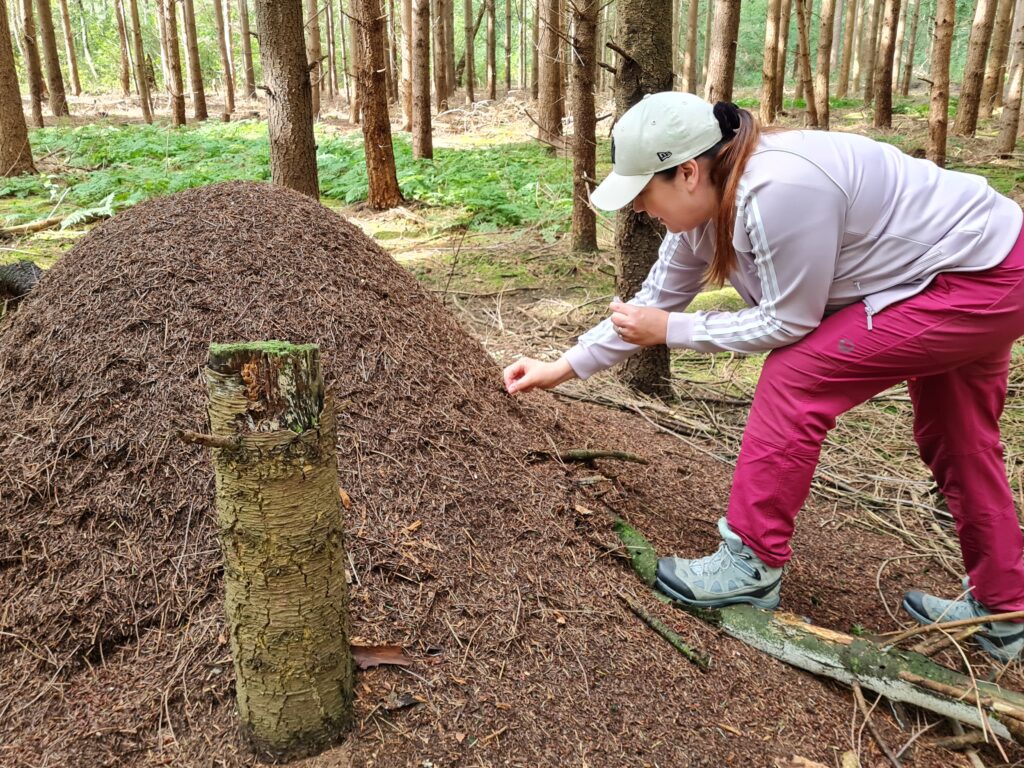
JK: In our group we study speciation and hybridization using wood ants as a model system. Writing this review was a group effort to systematically building a picture of the current studies on speciation in ants. It is meant for ant researchers who are interested in studying questions related to speciation, but also for speciation researchers who are looking to diversify into other model systems, like the ants. We hope this sparks more studies on speciation using ants as a model.
PH: This review was a nice opportunity for collaborating within the group. Our group has a wide range of expertise, ranging from chemical ecology and social evolution to genomics and hybridization, and the review allowed us to bring all of that together. It was also an opportunity to highlight how powerful ants can be for addressing long-standing questions in speciation. Like Jonna, I hope our work helps inspire researchers from both ant biology and speciation research to explore this intersection further.
MN: What was the biggest obstacle you had to overcome in this project?
PH: While my research uses ants as a study system, I don’t really think of myself as a myrmecologist. So, reading across the literature and drawing conclusions from similarities between clades involved having to learn more about ants beyond Formica. Working on the review was rewarding for that though. The other part was, as in any review, going through a large amount of literature. The initial search keywords matched concepts in other fields that necessitated manual curation of the results. My favorite is that apparently there are class of algorithms in computer science called ant colony optimization (ACO).
MN: Do you have any tips for others who are interested in doing related research?
JK: Many ant species and clades are well-studied and individual researchers have good ecological and genomic data on them. In some cases, the existing data could be used to study ecological drivers of divergence and genomic architecture of divergence with gene flow. The haploid males are a powerful way to acquire haplotype level information, they can be leveraged to get a more detailed picture of species barriers along the genome, especially incompatibilities.







Recent Comments